|
| 1. |
The Kuanzhai Alley or Kuanzhai Xiangyi (成都宽窄巷子) is made up of of three lanes or alleys that run parallel to each other, namely the Kuan (Wide Alley), Zhai (Narrow Alley) and Jing Xiangyi,
 |
| 2. |
Here's a place where old meets new, where traditional Ming and Qing styled courtyards and houses complete with gardens within huge walls and hutongs (narrow lanes) are situated side by side modern hotels, spas, villas, entertainment outlets, bars, pubs, eateries and sidewalk cafes.
 |
| 3. |
Stores selling foodstuff, snacks and lots of panda bear toys. Pandas are the mascot of Chengdu city.
 |
| 4. |
This blooming fruit tree looks like a star fruit (carambola) tree.
 |
| 5. |
The apple and pear trees are also fruiting now that is it in the middle of summer.
The weather was very warm and humid with temperatures exceeding 30 C, humidity more than 50%. I was already sweating after a short walk. The difference in temperatures is quite big with night dropping to about 26 C. Sunrise was at 6:30am and sunset at 7:30pm.
“Chengdu Jiuzhaigou Huanglong 9D7N - Day 2 Chengdu Kuanzhai Xiangyi Alley”, a copyrighted post, was written for My Malaysia Daily Photo blog by Autumn Belle @ http://mymalaysiadailyphoto.blogspot.com on 28 Aug 2013.
 |
| 6. |
The Chengdu city of today is full of skyscrapers with modern amenities and people live in high-rise apartment buildings.
 |
| 7. |
 |
| 8. |
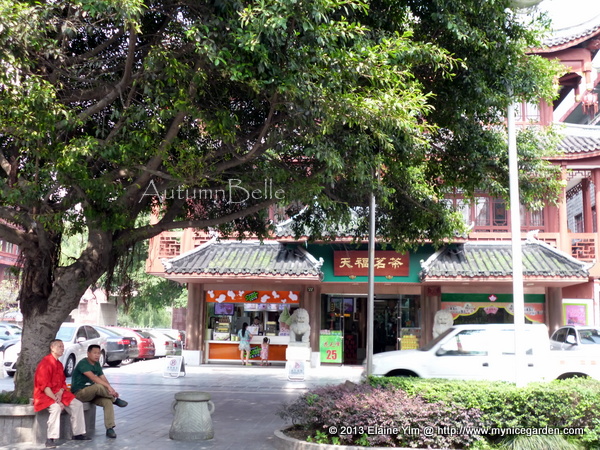
A modern food outlet selling sweets and confectionery.
 |
| 9. |
Reminders of an ancient walled city.
 |
| 10. |
I'm thinking how beautiful this maple tree will look in autumn.
 |
| 11. |
This stall sells local delicacies.
 |
| 12. |
An ancient stone statue stand guard beside a modern open-air cafe.
 |
| 13. |
 |
| 14. |
It is common to find stalls like this selling stringed magnolia flowers.
RMB 1 each. Some people buy to hang in their cars.
RMB 1 each. Some people buy to hang in their cars.
 |
| 15. |
A western cafe.
The whole area here in Kwanzhai Xiangyi is wifi enabled.
The whole area here in Kwanzhai Xiangyi is wifi enabled.
 |
| 16. |
A traditional tea house.
 |
| 17. |
Some lovely summer blooms.
 |
| 18. |
Stall selling the wu-lou gourds (calabash).
 |
| 19. |
Colourful wu-lous.
 |
| 20. |
There are some high-end embroidery, silk and textile stores.
 |
| 21 |
A metal door knocker with a lion head.
 |
| 22 |
A traditional tea house with bamboo chairs and wooden tables.
 |
| 23 |
A food stall selling traditional food.
They say that you can sit in one of the ancient tea houses and enjoy the world go by.
As the sun sets and dusk falls,
As the sun sets and dusk falls,
and with the aroma of food that wisp through the air,
it will remind you of days of long ago.
The night scene here is very exciting and vivid.
The night scene here is very exciting and vivid.
 |
| 24 |
Fried, grilled and braised food.
Everywhere one can't escape the scent of 'ma la'.
 |
| 25 |
Steamed dishes.
 |
| 26 |
This is the biggest and tallest banana plant I have ever seen!
 |
| 27 |
Dragon floss candy.
 |
| 28 |
A French restaurant.
 |
| 29. |
Maker of smoke pipes.
 |
| 30. |
Azaleas are blooming everywhere in Chengdu.
 |
| 31. |
Walled gardens.
The theme here is a garden city.
Ancient courtyard houses have huge walls that surrounds them.
Outsiders can't see what's inside these tall walls.
Inside are the proper house with inner courtyards and gardens within gardens.
The theme here is a garden city.
Ancient courtyard houses have huge walls that surrounds them.
Outsiders can't see what's inside these tall walls.
Inside are the proper house with inner courtyards and gardens within gardens.
 |
| 33. |
 |
| 34 |
Flower tea shop
 |
| 35. |
The 2 persons standing there are real, not statues!
 |
| 36 |
A monk having tea at Starbucks.
 |
| 37 |
At the cashier's counter of Starbucks.
 |
| 38 |
Summer blooms.
 |
| 39. |
Stall selling bolsters in various sizes.
 |
| 40. |
Italian ice-cream and desserts.
 |
| 41 |
Decor at an arts and craft shop.
 |
| 42 |
Decor at an arts and crafts shop.
 |
| 43 |
Clean and nice-looking washrooms.
 |
| 44 |
A bar.
 |
| 45 |
All things Panda.
 |
| 46 |
Live tortoises inside these cartoon shaped plastic bottles.
 |
| 47 |
Earlier, I saw a group of workers cutting down a big tree.
I guess that's why the Fire Engine was there.
I guess that's why the Fire Engine was there.
 |
| 48. |
A shady tree to provide some shade from the scorching sun.